
How to tell whether you need a workshop
Also called: WORKSHOP · MAKER SPACE · FAB LAB · PROTOTYPING FACILITY
A surprising number of good product ideas quietly run out of steam in the wrong room. Here is how to judge whether your product needs a workshop, and what good looks like.
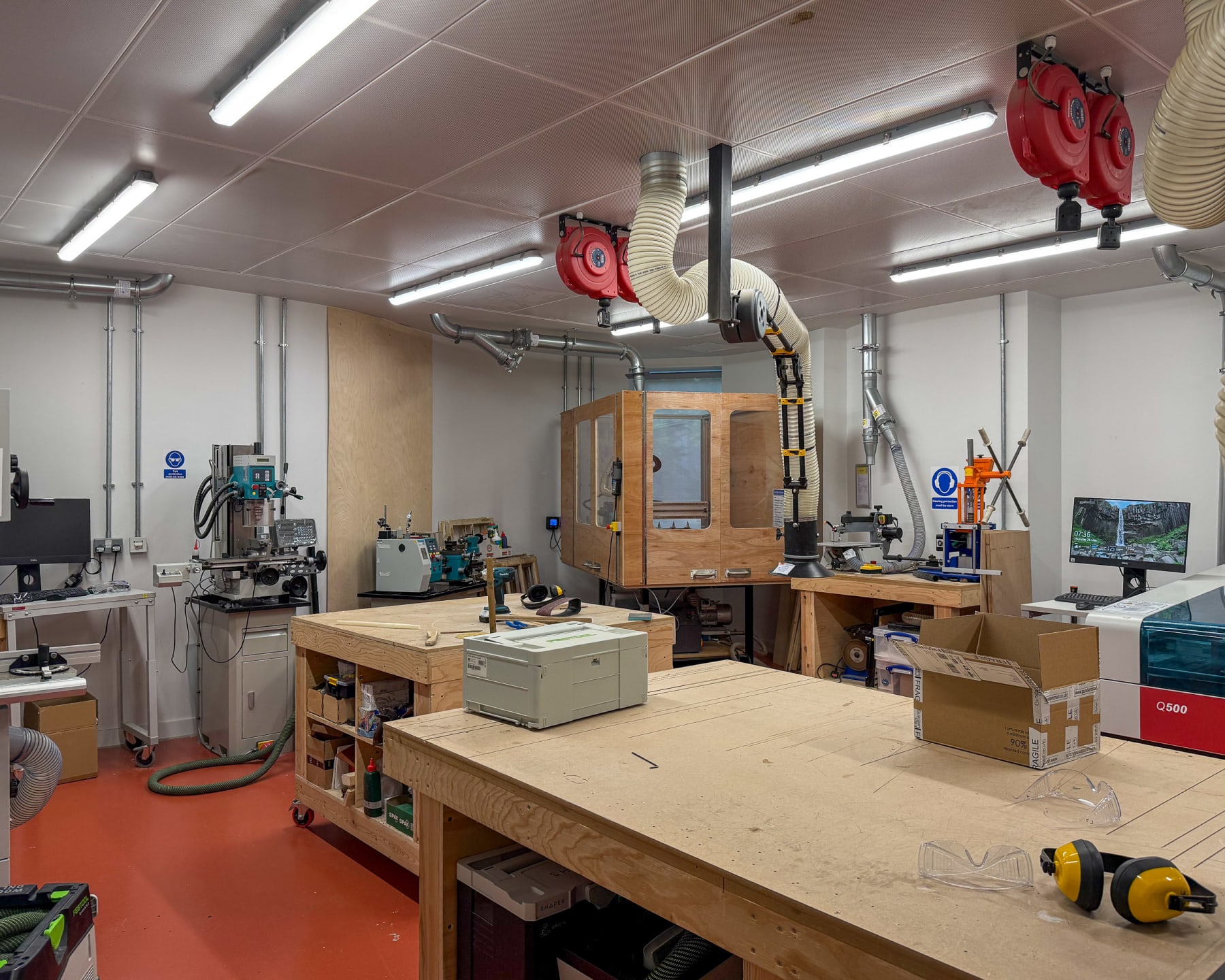
Plus X Innovation Brighton’s main prototyping workshop, with the CNC enclosure, large-format laser cutter and central assembly bench in one room.
Environment starts to matter the moment you move from concept to prototype. The right workshop buys speed of iteration and stops you designing around what you can make. Four kit categories, a few things that are not equipment, and an honest list of when you do not need one.
Not on a whiteboard, not in a pitch deck, but somewhere between the third printed iteration and the moment the maker realises the kitchen table cannot take much more of this. The decision of where you develop a physical product gets made by default, usually badly, and then it quietly shapes every later decision you make about that product.
This article is about getting that decision out of default mode. It is not an argument that every inventor needs a workshop. Plenty do not, at least not yet. It is a way to judge what kind of environment your specific product actually needs, what that environment will and will not change about your work, and what to look for if you decide it is time to find one.
I will use Plus X Innovation Brighton as the worked example throughout, because I am a member there and know the kit and the people well enough to be specific. The principles apply to any well-equipped workshop. The point is not Plus X Innovation, the point is the criteria.
When environment starts to matter
If you are still at concept stage, sketching, thinking aloud, working out what your product is for, the room you are in barely matters. A coffee shop is fine. A garage is fine. Your kitchen is fine. Environment is a distraction at this stage, not an advantage yet.
The moment you move from concept to prototype, you start needing to make things: accurately, repeatedly, with tools that mostly do not sit in a domestic setting. That is the threshold. Before it, you are working with ideas, and ideas travel light. After it, the wrong environment will slow you down by a factor that surprises people the first time they measure it.
The thing that surprises people is not the kit. It is the friction. Working from home, you avoid the bits of the build that need a particular tool you do not own, because borrowing or hiring or finding it takes a half-day each time. You start designing around what you can make this afternoon, not what the product actually needs. That shows up later as compromise baked into the product, the kind you cannot trace back to the moment you made it.
What environment changes about how you work
Two things, mainly.
First, speed of iteration. With the right kit on hand you can hold a printed prototype in the morning, modify the CAD over lunch, and have the next version printing by mid-afternoon. That cycle, repeated, is what turns a half-baked idea into a working product. The cycle is the engine of physical-product development, and friction in the cycle is the largest single cost most early-stage builds carry, even though nobody puts it on a budget line.
Second, what you stop avoiding. With a fablab a five-minute walk from your desk, you start cutting test rigs on the laser instead of bodging them out of cardboard. You start using the right material for the test instead of the closest one to hand. The decisions you make get cleaner because the path to the clean version is no longer expensive.
A concrete version of what cleaner decisions are worth. One consumer health product I helped redesign came out with fulfilment costs 8% lower than the version it replaced, and the decisions that got it there (pack size, assembly order, how the parts sit together in the box) were mostly made with the parts in hand, not on a screen. None of those decisions needed exotic kit. They needed the next iteration to be cheap enough that nobody hesitated to make it.
The kit list that actually earns its keep
Four categories cover most of what a well-equipped workshop gives you. They sound obvious; the value is knowing what each one is for in a development cycle.
THE FOUR CATEGORIES
Heavy workshop
PILLAR DRILL · BANDSAW · CNC ROUTER · MILL · LATHE · BENCH FABRICATION
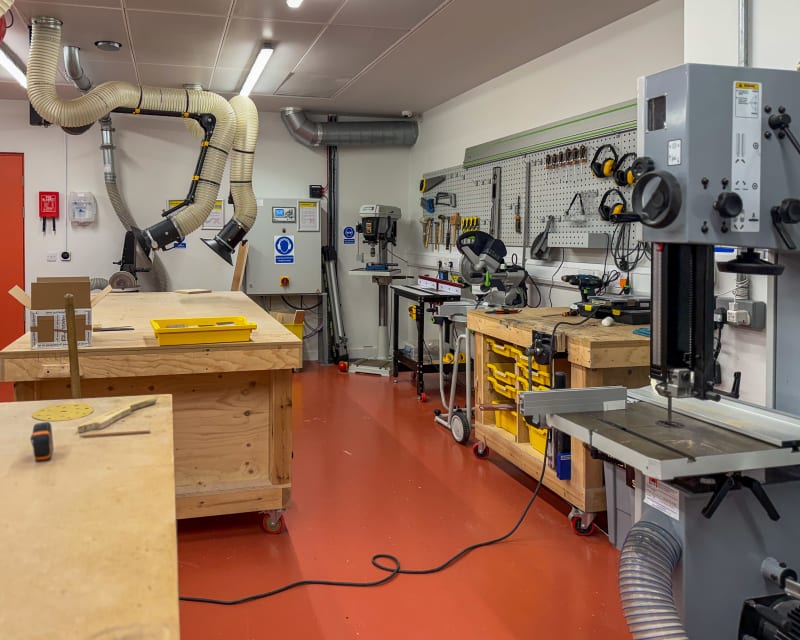
Bench work, hand fabrication and the big fixed machines, the things you cannot 3D print. Drills, saws, the bandsaw, vices, the boring kit that does most of the actual making. This is also where the CNC machining lives, an iTech large-format CNC router, a Roland MDX-540 benchtop CNC mill, a vertical bench mill and an Axminster bench lathe for turning metal stock. Easy to underestimate from outside; impossible to do without once you are in the build.
Fab lab
TROTEC LASERS · VINYL CUTTER · ELECTRONICS BENCH · 3D PRINTERS
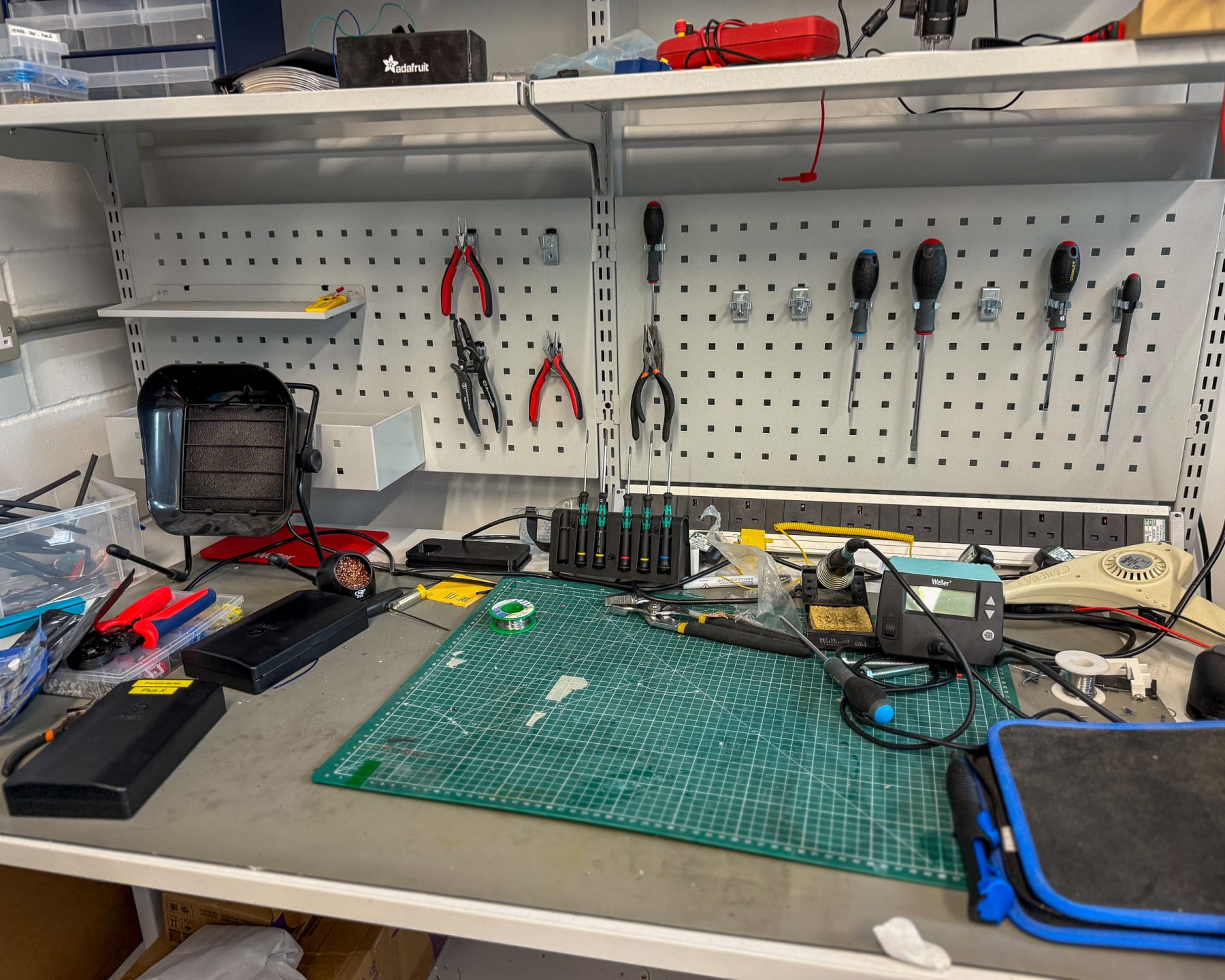
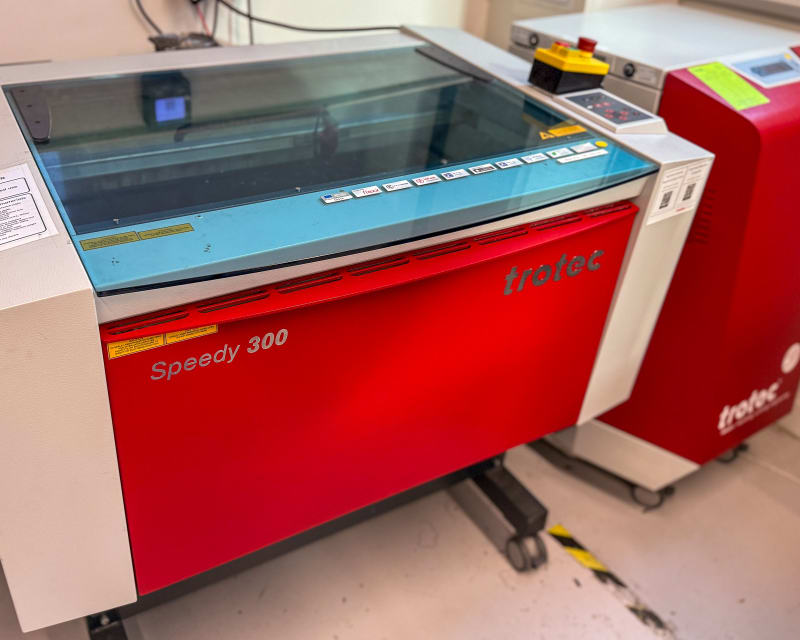
A large-format Trotec Q500 laser and a smaller Trotec Speedy 300, a vinyl cutter, an electronics bench and the 3D printers. The room that makes fast, accurate parts and the bits that talk to them. The laser alone changes how often you make test rigs: you end up making far more of them, and that is the right number, because every rig is a question answered cheaply before it gets expensive. The printers cover form and fit, less useful for end-use parts than most first-time inventors assume.
Finishing
SPRAY BOOTH · DISC SANDER · DETAIL BENCH · EXTRACTION · GOOD LIGHT
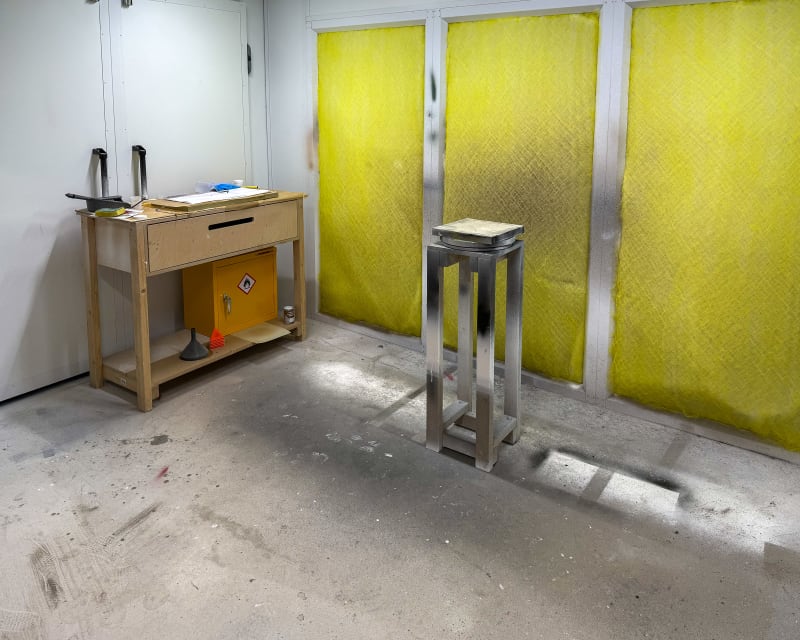
Paint, sanding, surface prep and the detail that turns a working part into a finished one. A spray booth, a disc sander, a small-parts bench, extraction and good light. Easy to skip, and obvious in the product when it has been skipped.
Assembly space
BIG BENCH · LAYOUT SPACE · FIT-UP · GLUE AND TAPE
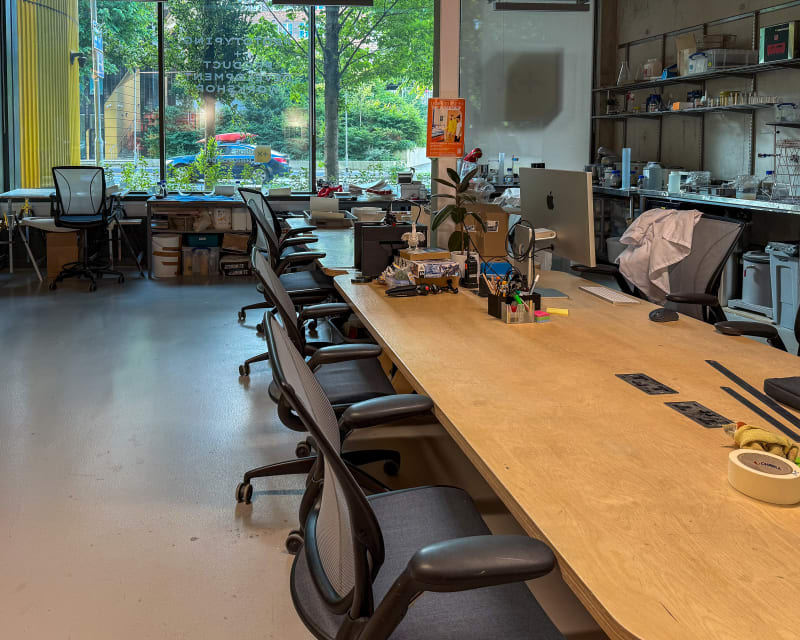
The in-between work where it all comes together. Most of prototyping is neither machining nor printing, it is the messy middle: laying parts out, fitting one thing to another, gluing, taping, photographing what you have so far. A big bench and room to work is what makes this possible, and a domestic kitchen is a slow, badly-lit version of that table.
If a workshop only ticks one or two of these boxes, you will spend half your time travelling between sites or going without. Look for the four together.
The bits that are not equipment
These are the harder ones to value, and the easier ones to dismiss until you have had them.
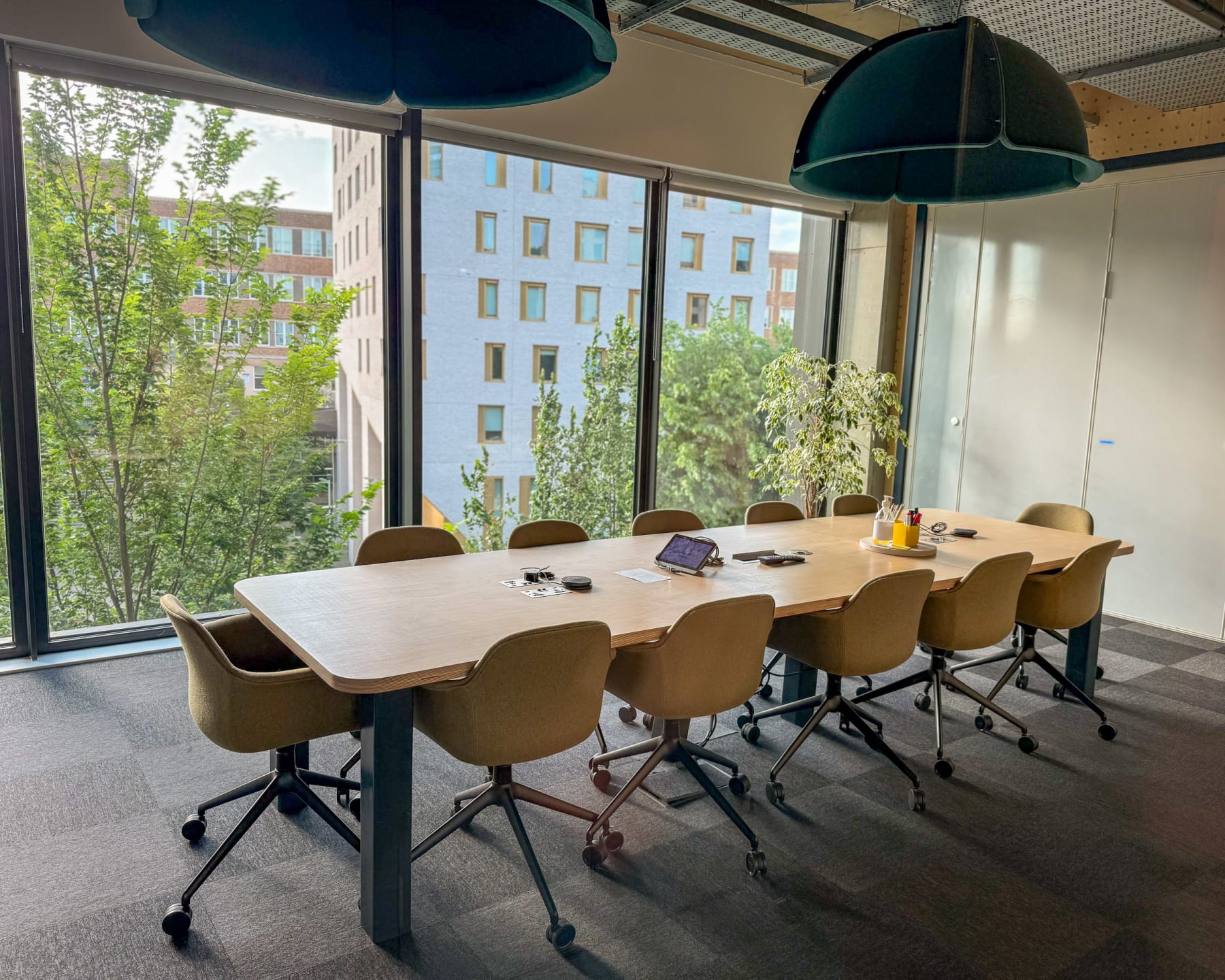
A proper workshop building gives you a front-of-house presence, a real address that a client or a collaborator can walk into. This matters more than people expect for a one-person practice; it stops you sounding like you operate out of a spare bedroom even if you partly do.
It gives you other founders nearby. Cross-pollination is a fuzzy phrase, so a concrete version: someone two desks over has solved your bearing problem, and you find out by accident over coffee. The introductions and the small unblocking favours happen because the building generates them, not because you went looking.
It gives you visible activity. A building that is busy with making attracts people who care about making, which means the next collaborator or contractor or pilot user is more likely to find you sitting in it than sitting at home.
When you do not need this
A short and honest counter-section, because the sales pitch in the other direction is loud.
You do not need this if you are still at concept stage, working out what the product is. You do not need it if your product is software with light hardware. You do not need it if you already have workshop access through a partner or a former employer. You probably do not need it if your product is on a multi-year arc and monthly access fees would compound past what bringing the kit in-house once would cost. And you do not need it if the friction of getting to the workshop (commute, security, opening hours) would itself eat the speed-of-iteration gain.
If two or more of those apply, hold off. Revisit the question when they change.
What good looks like, and what to ask
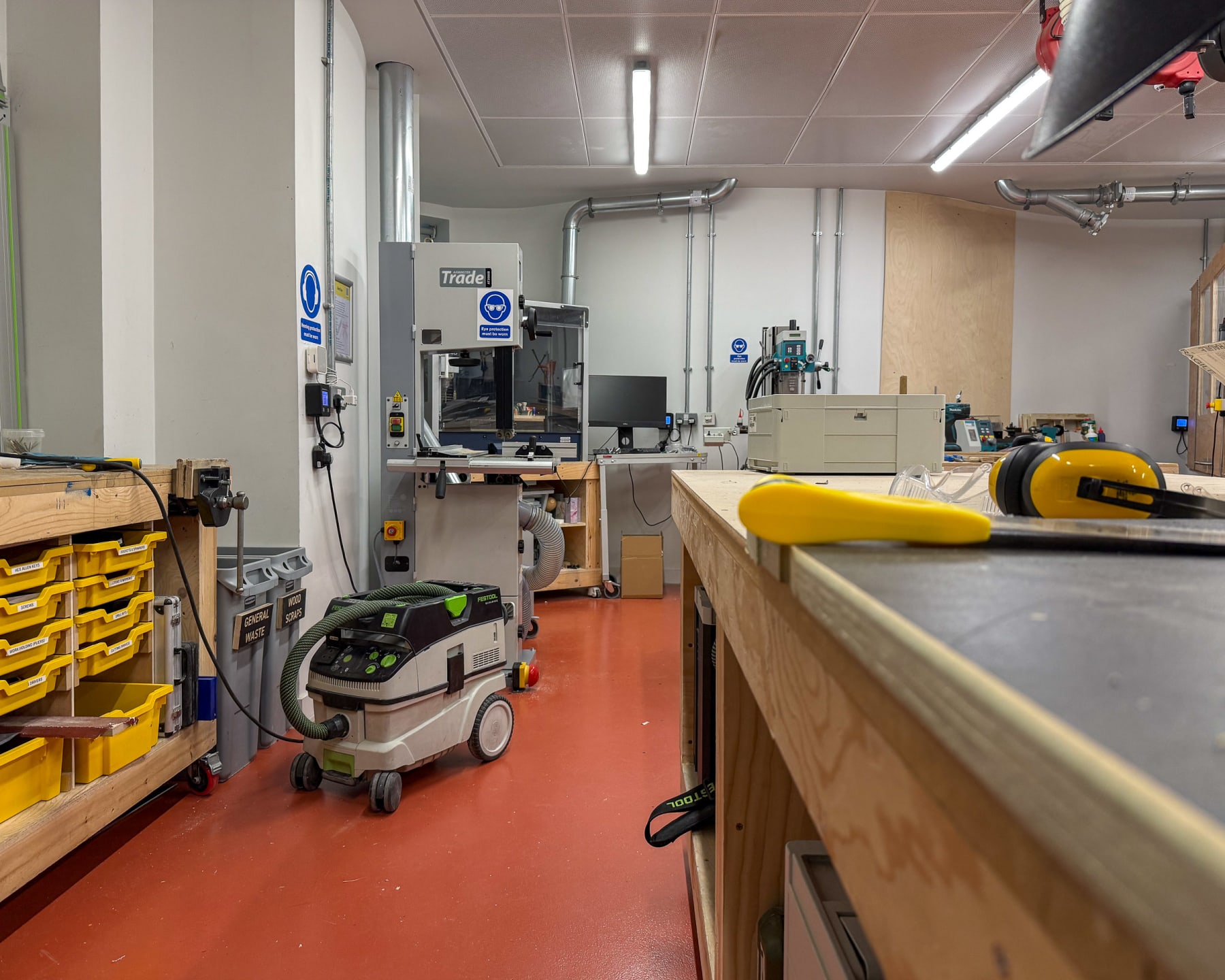
If you have decided you do need a workshop, the criteria are roughly these.
Kit breadth. All four categories above, in one building, ideally on one membership.
Technical staff on site. Someone who knows the laser, the CNC, the printers. A workshop without staff is a workshop you teach yourself, slowly.
Member quality. Look at who else is in there. If you would happily borrow their judgement, the building is doing its job.
Day-rate versus membership maths. Run it against the number of half-days you would realistically use it per month. To make that concrete: at the time of writing, memberships at Plus X Innovation start at £150 a month plus VAT (tiers and workshop access vary, so check the current rates). If a bought-in half-day of workshop time or tool hire would cost you somewhere between £40 and £80, the crossover lands at two or three half-days a month. Past the prototype threshold, you will probably use more than that.
Location versus your customer base. If your customers are in the building or nearby, that is a quiet compounding advantage.
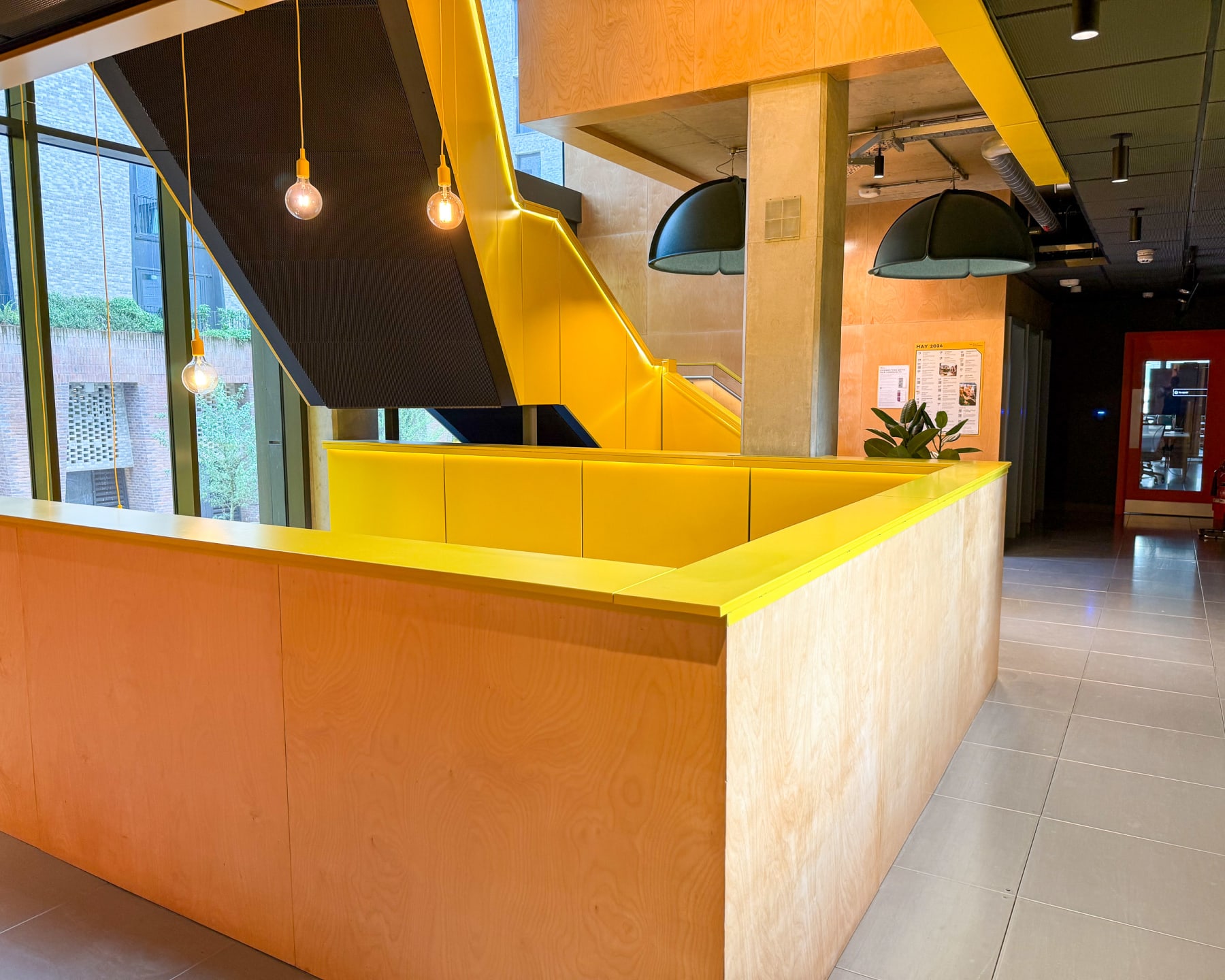
Plus X Innovation Brighton is the worked example I know best. It is on the four-kit-categories test (heavy workshop, fab lab including a well-kitted laser bench, finishing, and assembly space), it has technical staff on site, the member base is mixed in the useful direction (engineers, designers, makers, founders), and the building has a real front-of-house and a café you can take a client to. The work that has crossed my own bench there runs from medical devices to music hardware to furniture and retail kit, which is a fair test of whether one building’s kit list can cover a working practice. Other workshop ecosystems will tick the same boxes differently. The criteria are the durable bit.
FROM THE NOTEBOOK · A SHORT PERSONAL NOTE
I work out of Plus X Innovation Brighton in Moulsecoomb. My route here ran through FIELD in central Brighton, where I was a pilot member when it opened, then LeftField, which six of us from FIELD formed in the years between, before joining Plus X Innovation Brighton as a member when it opened. The building has since grown to 460+ members. I am over 25 years into mechanical engineering practice now, and the speed-of-iteration point above is something I would not have understood at the start, but I would back it on the evidence by now.

If you are not sure which side of the threshold you are on
This is the most common position to be in, and it is not a problem to be in it. The decision is genuinely a judgement call, and the cost of getting it wrong is real on both sides (too early, you pay for kit you are not using; too late, you embed friction into the build that the product carries forever).
If you would like a hand thinking it through, there is a free Viability Sprint GPT on the site you can put a product idea through first, a structured first-pass before you spend money on anyone. Or get in touch and we can talk it through.
BUILT BY CAST IRON CAD · INNOVATE ENGINEER IS A SUPPORTING PRACTICE OF CAST IRON CAD LTD